Poly1Rover — Mars Mini-Rover
Cal Poly · January 2026 – Present
01Overview
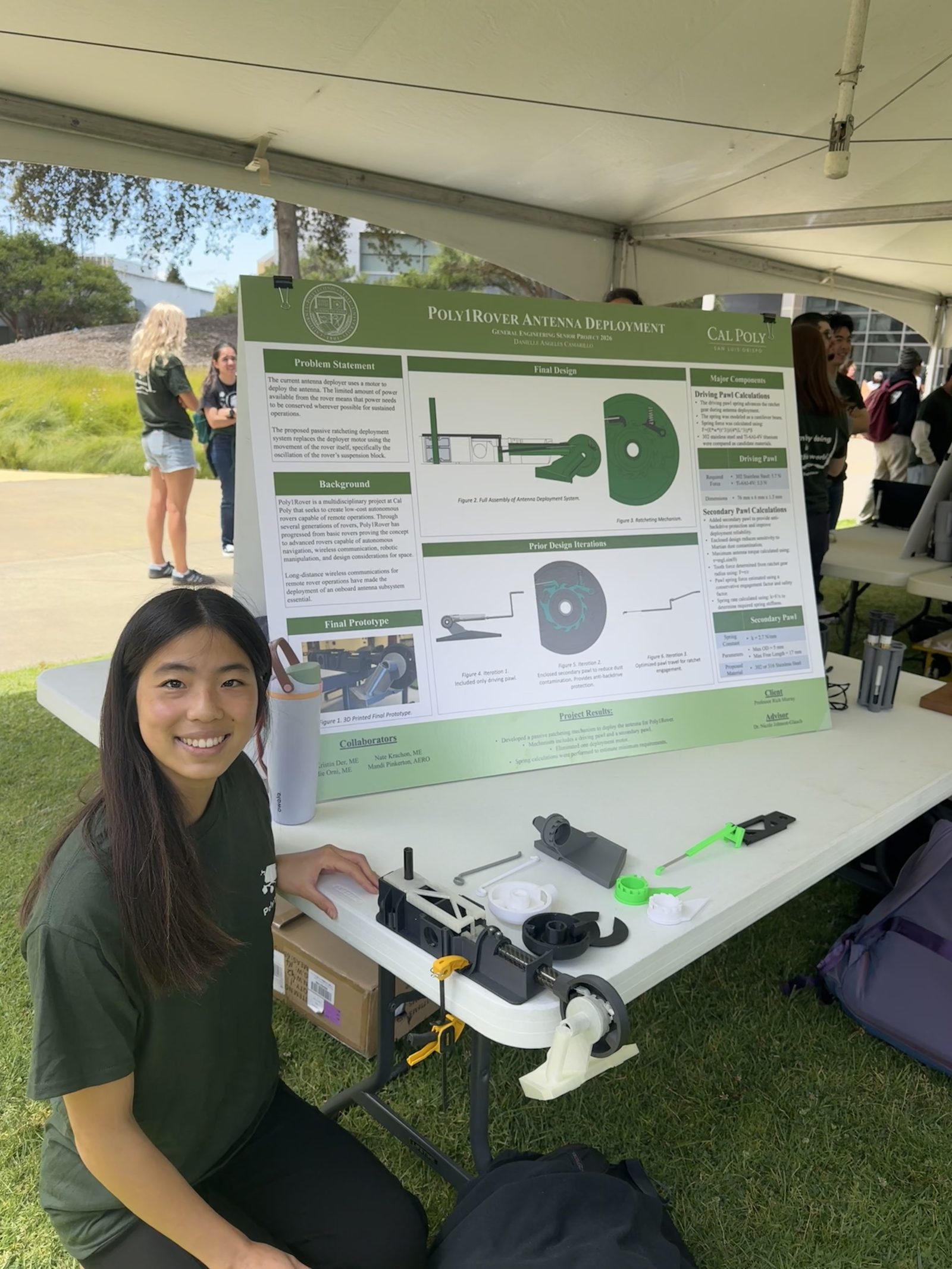
On Poly1Rover, Cal Poly's Mars mini-rover team, I developed a suspension-driven linkage for a ratchet-and-pawl antenna deployment mechanism. The mechanism uses the rover's own suspension travel to enable smooth, controlled antenna deployment.
02The Challenge
The antenna needed a reliable way to deploy on the rover without adding a dedicated motor, which would add complexity, mass, and another subsystem to power and control. The mechanism had to translate an existing motion on the rover — suspension travel — into controlled, repeatable antenna deployment.
03My Role
- Developed a suspension-driven linkage for a ratchet-and-pawl antenna deployment system.
- Iterated mechanical designs in SolidWorks.
- Built and evaluated 3D-printed prototypes and hand-fabricated components.
- Improved fit, manufacturability, and integration with the rover.
- Selected to represent the team at Cal Poly's Engineering Expo and present the team's design and technical work.
04Engineering Process
The mechanism moved from concept to hardware through repeated cycles in SolidWorks and on the bench: model the linkage, print or fabricate it, mount it to the rover's suspension, and check whether it deployed the antenna cleanly and repeatably.
05Design Decisions
The core decision was driving deployment off suspension travel rather than a dedicated motor — this eliminates the need for a dedicated motor and reduces system complexity, at the cost of coupling deployment timing to how the rover's suspension moves. Add further tradeoffs here (linkage geometry, pawl engagement, material choices) as you document them.
06Testing / Validation
Prototypes were built and evaluated using 3D-printed parts and hand-fabricated components, checking fit, manufacturability, and integration with the rover through iteration.
07Outcome
The design eliminates the need for a dedicated deployment motor and reduces system complexity. I was selected to represent the team at Cal Poly's Engineering Expo and present the design and technical work.
08What I Learned
Add a short technical reflection here — what you learned about designing mechanisms that borrow motion from an existing subsystem, or about presenting technical work at Engineering Expo.